SMALL STOCKS VS. BIG STOCKS:
A REAL LONG-TERM PERSPECTIVE
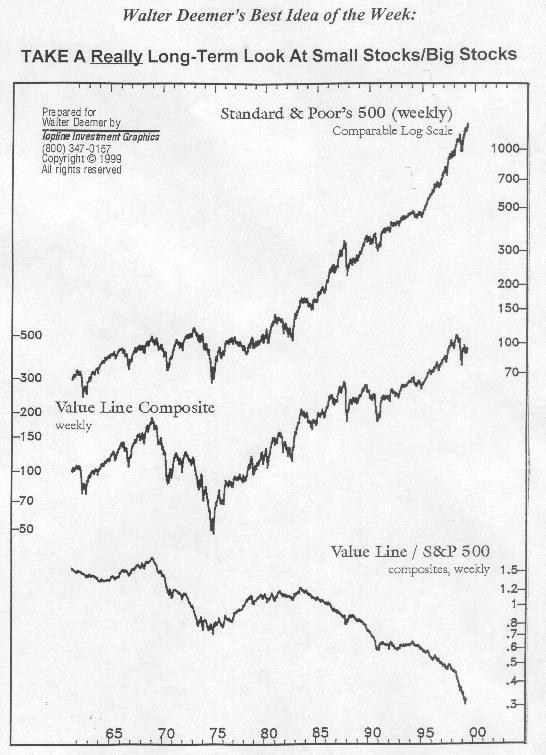
A number of charts crossed my desk this week that showed a small cap or value index plotted against the S&P 500. Unfortunately, none of them showed the relationship before 1975, so all of them missed both the Nifty Fifty era and the small-stock collapse of 1968-74. I therefore asked John Carder, of Topline Investment Graphics, to plot a chart of the Value Line index vs. the S&P 500 all the way back to 1961.
As you'll see, there were at least four distinct eras during that time: The Small Speculative Stock Era (1965-69), The Nifty Fifty Era (1969-74), The Unwinding Of The Nifty Fifty Era (1974-1983), and The Indexing Era (1983-present). It is worth noting that during the 34 years since 1964, small stocks outperformed big stocks almost half the time: the five years from 1965-69 and the ten years from 1974-1983.
A couple of comments: The Nifty Fifty Era was accompanied by a tremendous bear market in small stocks (the Value Line Index, as well as an unweighted NYSE index, fell 75% from 1968 to 1974, and an unweighted American Stock Exchange index plummeted 88% during the same time) -- and it was the combination of small stocks rebounding from those losses together with the unwinding of the Nifty Fifty Era that allowed small stocks to outperform big stocks for the next decade. (Any similarities with the current market environment may be a lot more than coincidental.) In addition, the Indexing Era, with its reductio ad absurdum strategy that allocates more and more assets to the stocks that have appreciated the most, has created, during the past 16 years, what is probably the largest underperformance by small stocks, in terms of both time and amplitude, ever. I have no idea what is going to reverse this trend, or when it will do so (or even if the reversal may have already happened) -- but I do know for sure that it WILL reverse, and that small stocks will someday again outperform big stocks for an extended period of time. At this point, though, the rubber band has stretched further than anybody ever dreamed that it would, and there is no way of knowing how much further it may stretch before it finally starts contracting again.
-- Walter Deemer